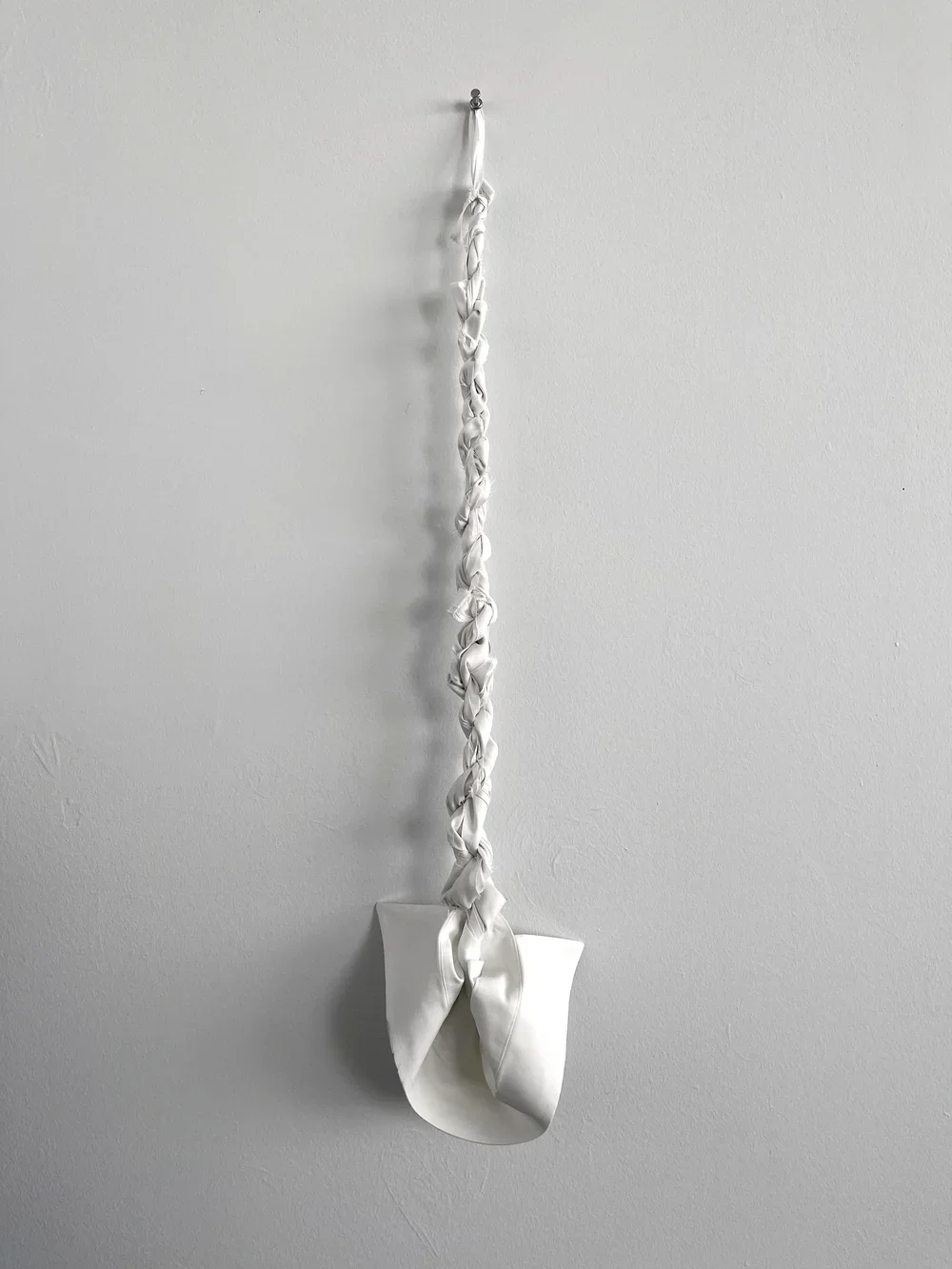
Spade by Jess Blaustein, 2020
The spade hangs quietly on the wall. Beside it a label reads:
Spade
2020
Cut-up and corded white-collared shirt
30 x 6 x 3inches
Spade, by artist Jess Blaustein, is a single white-collared shirt manipulated such that it takes the exact shape of a spade, the collar borrowing the curve and dent of a shovel, the sleeves corded together to become a handle. A separate, smaller piece of cord made by the artist connects Spade to the wall, emphasizing its weight as it pulls the cord down. Work weighs.
The piece is beautiful. It is delicate, yet is a rendering of an object that is robust; soft, when a spade would usually be hard. It is fragile, when spades are built to be banged around. It is made of a pliable and gentle material, one created to envelop the body and warm it, and yet it has been twisted and turned and knotted. Contradictions abound (and is that not the case with work, too, much of the time?).
The choice of the words “the art of work” to describe the exhibition Spade was originally conceived for is striking. In German, the word for “art,” as in “high art,” is Kunst, but the word Art is used in the sense of the “art of work,” or the “art of war.” This definition of the word “art” refers to “the ways of,” “the qualities of,” or “the practice of,” and speaks directly to craft. The theory of craft tells us that it is the practice of and commitment to making in relationship with one’s materials, and this over time. Blaustein’s piece is not simply a representation of an object used in work; rather, it reveals the handiwork itself, driving the viewer back to the truly embodied nature of work as something that happens through and to bodies, especially the bodies of those who carry spades. In this, Spade honors the true art of work. (Incidentally, the German word for “craft” is Handwerk.) Work is something we wear — as uniform, as title, as status, as line, or as scar; and it is something that can wear us down.
That an object so associated with manual labor should be made with – and described as – a white-collared shirt is no accident, calling to mind the terms “white-collar” and “blue-collar” and all the ways in which they are put in opposition. We are encouraged to think of who is doing which kind of work and who benefits from it, and in what ways. Of the complex knots of hierarchical relationships and systems of oppression, of networks of commerce and of labor, of race and of gender, of rich and of poor. We are invited to reflect on starched shirts and stained overalls, on luxury and survival, on who gets to enjoy a soft white collar, and who spends their days banging a spade.
Blaustein’s Spade hangs quietly on the wall, but there is little else that is quiet about it.
To view more of Jess Blaustein’s work, visit: https://www.b-plot.org/